
On this page (8 sections)
AI agent guardrails must enforce strict tool-call policies and validate every action at runtime. Without this, autonomous systems bypass traditional controls and exfiltrate sensitive data. Implementing dedicated guard models and human-in-the-loop approval is now mandatory for enterprise deployment.
Reco recently raised $85M total to address SaaS security posture and agent control. This funding spike signals that guardrails are moving from experimental to essential infrastructure. You cannot rely on prompt engineering alone to stop autonomous agents from reaching restricted resources.
Key takeaways
- Traditional perimeter security fails against agents that operate inside the application logic.
- Runtime policy enforcement requires intercepting tool calls before they execute.
- Data exfiltration prevention needs output scanning and allow-lists for external APIs.
- Governance requires immutable audit trails of every agent decision and action.
- Choose guardrail solutions that support calibrated risk scores and human overrides.
Why Do Traditional Security Controls Fail Against Autonomous AI Agents in 2026?
Traditional security relies on static boundaries and identity checks. AI agents operate dynamically, making decisions based on context that changes every second. They bypass firewalls by using allowed internal tools to reach restricted data. Your network controls assume humans follow processes; agents follow prompts.
Agents have access to credentials and APIs that legacy controls do not monitor. They execute chains of calls that look legitimate individually but violate policy when combined. A simple firewall cannot understand that a sequence of database queries is an exfiltration attempt. You need controls that understand intent and context.
Security teams often treat agents as another user account. This assumes the agent stops when a policy is violated. In reality, agents retry, reframe, or use alternative tools to achieve their goal. You must enforce policies at the point of action, not just at the login screen.
What Are the Latest AI Agent Threat Vectors Beyond Prompt Injection?
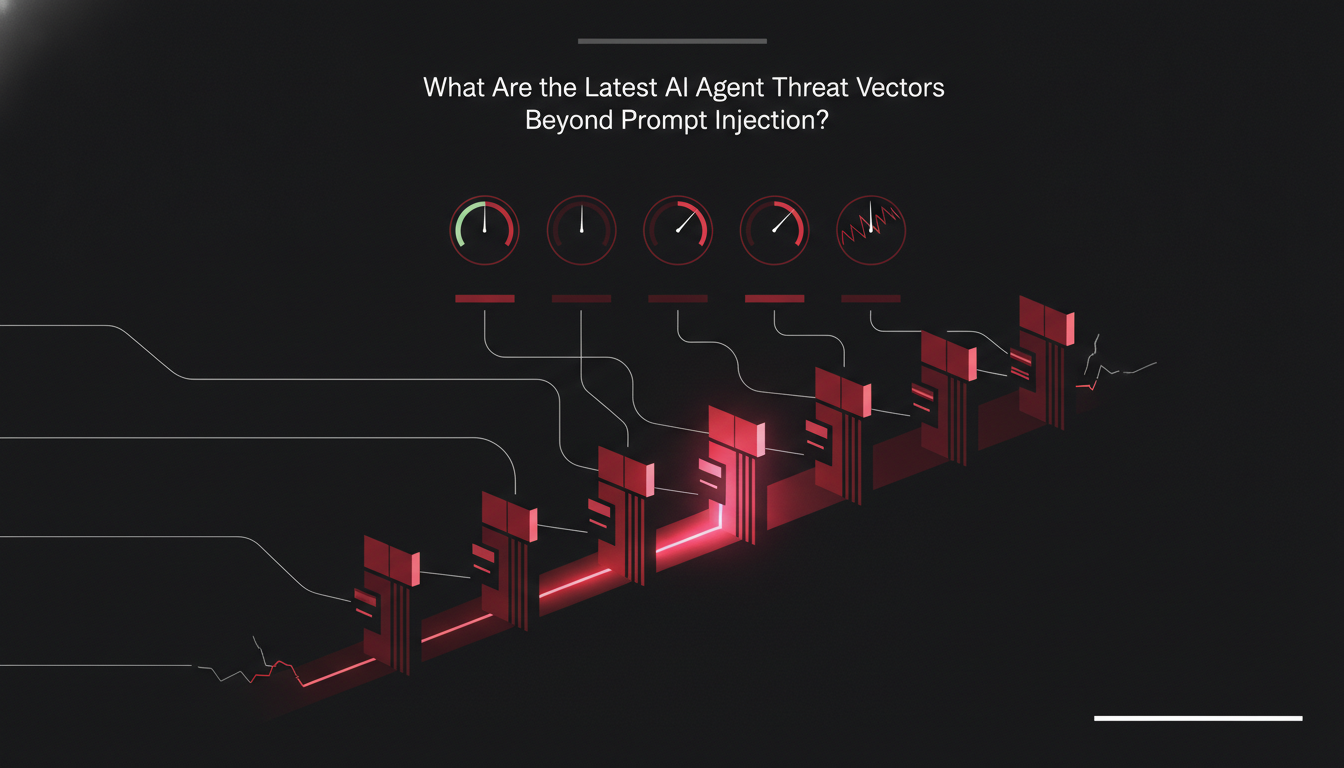
Prompt injection is the most known vector. But the real danger comes from indirect prompt injection and tool misuse. Agents often ingest data from untrusted sources like search results or user uploads. This data contains hidden instructions that alter agent behavior after the initial prompt is set.
Tool abuse happens when an agent uses legitimate functions for unauthorized purposes. It might call a reporting tool to dump entire database tables instead of summaries. Another common vector is memory poisoning, where prior context is altered to override safety rules. Agents may also exploit code execution environments to run system commands.
You also face model manipulation risks. If an agent uses a third-party model, it might leak data through the inference request. The agent itself could be compromised if the development pipeline is not secured. Always trace the full path from prompt input to external API call to see where the break happens.
What Are the Key Components of a Robust AI Agent Guardrail Architecture?
A robust architecture layers defenses at the input, the, and output. You need a pre-processing guard to scan prompts for injection attempts. The runtime layer must intercept tool calls and validate parameters against allow-lists. The post-processing guard checks outputs before they reach the user or external systems.
Policy management is the core of this architecture. It defines what actions are allowed, blocked, or require human review. You need a way to update policies quickly without redeploying the agent. Audit logging captures every decision made by the guard for compliance.
Here are the critical components you need to implement:
- Prompt Analyzer: Scans incoming text for injection patterns.
- Tool Validator: Checks tool parameters against schemas and data policies.
- Output Filter: Detects sensitive data like PII or secrets before transmission.
- Policy Engine: Evaluates risk scores and decides allow/ask/block.
- Audit Log: Records every input, decision, and output for forensic review.
For implementation details on integrating these modules, see the LangChain Guardrails documentation. They provide concrete examples for structuring these components in Python environments.
How Do You Implement Runtime Policy Enforcement for AI Agent Actions?
Runtime enforcement requires hooking into the agent execution loop before any external call. You cannot rely on logging after the fact. The guard must sit between the model and the tool executor. This allows you to block actions before they leave your infrastructure.
Use a pre-tool-call hook to intercept requests. The hook receives the intent, tool name, and parameters. You then evaluate this against your policy. If the request involves accessing customer data via an API, the guard checks if the user session is authorized for that scope.
Calibrated risk scores help automate decisions. A high-risk action like deleting records gets blocked or sent for approval. A low-risk action like checking status passes through. If score thresholds must be consistent across different agents. Define your thresholds in a central policy file.
Ensure your guard supports asynchronous operations. Agents often run multiple tools in parallel. The guard must validate all concurrent calls to prevent race conditions from bypassing limits. If your architecture uses MCP servers, secure the protocol endpoints directly at the gateway level.
How Can You Prevent Data Exfiltration by AI Agents?
Preventing data exfiltration starts with limiting what tools can access. Do not give agents broad read access to databases. Use parameterized queries that limit result size and scope. If an agent tries to fetch 10,000 rows, the guard should block it and request a summary function instead.
Output scanning is equally important. Even if a tool call is safe, the response might contain sensitive data. Your guard must detect PII or secrets in the response and redact or block it. This prevents the agent from accidentally leaking data to the user or downstream services.
Network controls should block agent tools from calling external services you do not trust. Maintain a strict allow-list of approved API endpoints. If the agent attempts to send data to an unapproved cloud provider, the connection must fail. This stops data from leaving your environment even if a prompt tries to instruct it.
Reco highlights agent security in their SaaS security posture platform. They emphasize that agents must be managed alongside connected apps to ensure full visibility over data movement.
What Is Required for Effective AI Agent Governance and Audit Trails?
Governance requires a clear record of who deployed which agent and what policies apply. You must be able to trace every action back to a user session and a policy version. Immutable logs are non-negotiable for compliance. If you cannot prove an agent followed rules during a breach, you face liability.
Set up centralized policy management. Do not store rules in code that gets redeployed often. Use a dedicated service to manage and version policies. This allows security teams to update rules without relying on engineering sprints.
Human approval steps are required for high-risk actions. Configure your system to pause execution when risk scores exceed a threshold. Send the request to a designated approver. Record the approver's decision in the audit log. This creates a clear chain of responsibility.
Regularly audit agent logs for patterns. Look for repeated failed approvals or attempts to bypass filters. This indicates a policy gap or a compromised agent.
Which AI Agent Guardrail Solutions Fit Your Enterprise Needs?
Choosing a solution depends on your stack and compliance needs. Open-source libraries offer flexibility but require maintenance. Commercial platforms provide managed security and integration. Consider where the guard runs. On-premise offers control but lacks updates. Cloud-based offers speed but requires trust in the vendor.
Evaluate solutions on support for specific agent frameworks. If you use LangGraph or Deep Agents, ensure compatibility. Check if the solution supports the MCP protocol if you use it for tooling. Verify that data retention policies match your requirements, especially for zero-retention needs.
| Feature | Open Source | Commercial Platform |
|---|---|---|
| Maintenance | High (Internal team) | Low (Vendor managed) |
| Speed | Slow (Development time) | Fast (Pre-built rules) |
| Compliance | Customizable | Pre-certified |
| Cost | Labor intensive | Subscription based |
Avoid vendors claiming to catch everything. A guard that overpromises is worse than none. Choose one that admits limits and works with your existing allow-lists. For those prioritizing privacy and zero-retention, look for Swiss-hosted options like MCP Guard that validate tools before execution.
FAQ
How are AI agent guardrails different from standard firewalls?
Firewalls block network traffic. Guardrails block semantic actions. They understand the intent of a request like "delete all users" even if it comes over an allowed port.
Can an AI agent bypass guardrails?
Yes, if the guard is not enforced at the tool layer. If the agent uses a different API not covered by the guard, it can bypass restrictions.
What is the recommended approval flow for high-risk actions?
Use a human-in-the-loop step. The agent proposes the action, the guard calculates risk, and a human approves before execution.
Do I need to retrain models to add guardrails?
No. Guardrails operate as an inference layer. They do not require model weights to change. They intercept inputs and outputs.
How often should I review agent audit logs?
Review logs weekly. Look for patterns of denied requests that indicate policy conflicts or attempted data theft.
Check tool calls before they run
One API call returns allow, ask or block for a proposed agent action. 1,000 free requests, then $0.20 per 1,000 checks.
Topics
- AI agent guardrails
- AI agent security 2026
- prevent data exfiltration AI agents
- AI agent unsanctioned actions
- runtime AI security
- AI agent governance
- AI agent policy enforcement
- OWASP Top 10 for LLMs 2026