
On this page (9 sections)
An AI agent trust boundary is the point where you stop trusting the agent's own reasoning and require an external verdict before an action executes. It is per-action, not per-host: the boundary moves with every tool call, so you enforce it at runtime. The most recent knowledge-base treatment of agent-to-agent trust boundaries I could find is dated August 21, 2026, and it is framed around multi-agent workflows — while most teams still break on the single-agent case.
Key takeaways
- A trust boundary is a decision point, not a perimeter. If nothing evaluates the action, there is no boundary.
- Every tool call is a boundary transition. Policy checks belong at each one, not at session start.
- Allow-lists and least privilege shrink the surface. They do not evaluate intent, which is what changes at runtime.
- A score you have not calibrated against labeled traffic is decoration. Calibrate or do not ship it.
- Logging is not enforcement. A log line after the write already happened is a postmortem, not a control.
What is an AI agent trust boundary?
An AI agent trust boundary is the set of transitions where the agent's output stops being treated as a suggestion and starts being treated as an instruction to a system that can change state. The glossary definition of an AI agent trust boundary frames it as the line between what the agent may decide alone and what requires external authorization.
That line is not drawn once. It is redrawn at every call, because the inputs change: the user prompt, the retrieved context, the tool result from three steps ago. A boundary that only exists at deploy time is a diagram, not a control.
The practical test is simple. Take any action your agent can take — sending mail, writing to a database, calling a payments API. Ask: what evaluated this specific call, with this specific intent, before it ran? If the answer is "the system prompt," you do not have a boundary. You have a hope.
Why do traditional trust boundaries fail for AI agents?
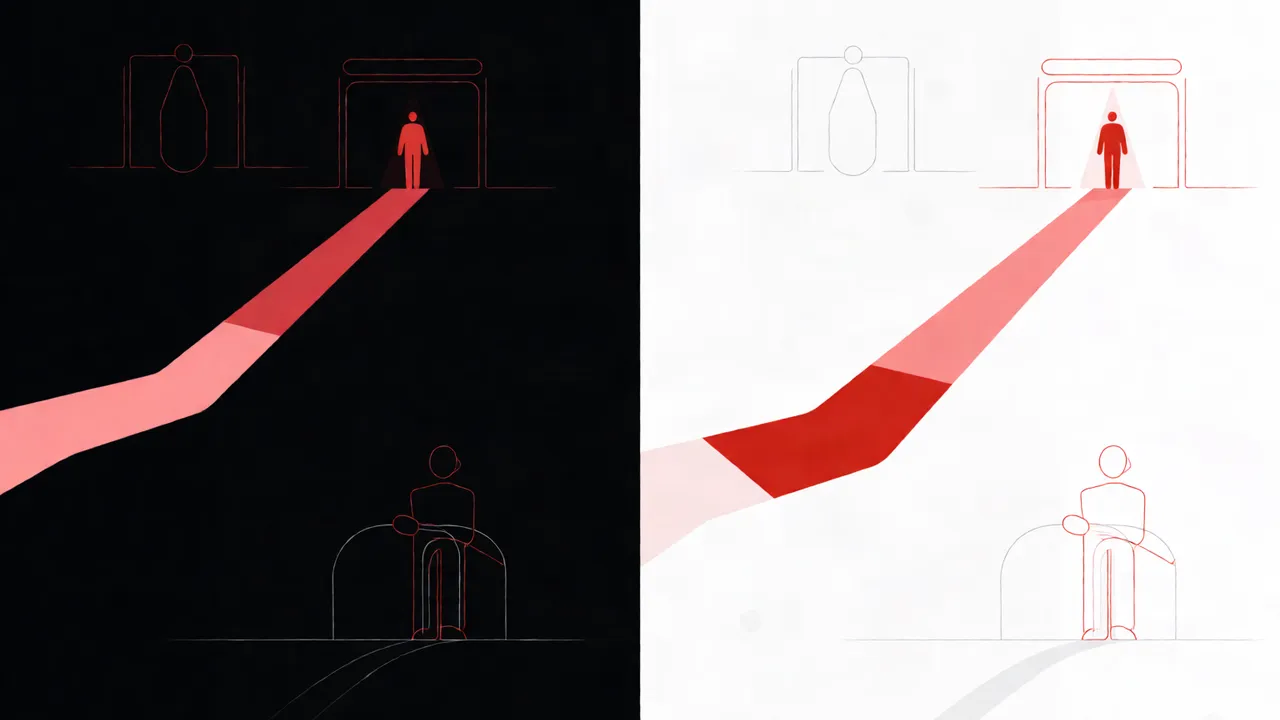
Traditional trust boundaries assume the principal is stable and the request is deterministic. An agent is neither. The same credentials issue a benign read at 09:00 and a bulk export at 09:04, and only the second one should stop — which is exactly the distinction a network segment or service account cannot express.
| Attribute | Traditional trust boundary | AI agent trust boundary |
|---|---|---|
| Unit of enforcement | Host, segment, service account | Individual action / tool call |
| Lifetime | Stable, changes on deploy | Re-evaluated per call |
| Who decides | Static config, IAM policy | Policy engine at runtime |
| Failure mode | Silent until exploited | Drifts with prompt and context |
| Evidence produced | Access log | Verdict, calibrated score, stated intent |
The failure mode on the right is the one that hurts. An agent does not need to be compromised to cross a line. It needs a plausible reason. A tool result that says "the user asked you to export the table" is enough, and no firewall sees it. That is why threat modeling for AI agents has to start from the action, not the network.
What does runtime enforcement actually do for AI agents?

Runtime enforcement means an external component receives the action and the agent's stated intent, evaluates them against policy, and returns a verdict before the action executes: allow, ask, or block. The agent does not grade its own homework. Something outside the model decides, and the decision is logged with the score that produced it.
This is the core of a control plane for agents. If you are centralizing this rather than bolting a check onto one tool, implementing an AI agent control plane is the longer version of this section.
The mechanism is deliberately boring:
- The agent proposes a tool call with a declared intent string.
- A pre-tool-call hook sends action + intent + context to the policy endpoint.
- The endpoint returns a verdict and a calibrated score.
- The hook allows, pauses for approval, or aborts and returns the reason to the model.
Step 4 matters more than people expect. Returning a structured refusal — not a silent failure — lets the agent replan instead of retrying the same blocked call in a loop.
How do you define and scope trust boundaries for your agents?
Scope boundaries by data class and reversibility, not by tool name. A read of public docs and a read of customer records are the same tool call and completely different boundaries. Sort every capability your agent has into four buckets, then write the policy from the buckets.
- Read, public. Allow by default. Log for volume anomalies only.
- Read, sensitive. Allow with scope limits — row counts, tenant isolation, field-level redaction.
- Write, reversible. Allow with rate limits and a rollback path.
- Write, irreversible, or externally visible. Ask. Always. Sending mail, moving money, deleting rows, posting publicly.
This is where least privilege for AI agents does its work: shrink the credential so the worst-case action is smaller. Least privilege and runtime checks are complements, not substitutes. Least privilege limits what is reachable; the policy check decides what is appropriate right now.
How do you implement policy checks at every agent action?
Put the check in the tool-call path, not in the prompt and not in a post-hoc log pipeline. If the check is not on the critical path, it is telemetry.
Concretely, with MCP Guard:
You get back a verdict and a score. Wire that into a pre-tool-call hook so nothing reaches the real tool until the verdict comes back. The table below is the decision contract I would hold yourself to.
| Verdict | Fires when | What happens next |
|---|---|---|
| allow | Action matches policy, intent is consistent, no sensitive sink | Tool call proceeds, verdict logged |
| ask | Action is irreversible, externally visible, or crosses a data class | Call pauses; a human approves or denies with the intent attached |
| block | Action violates policy, or intent and action disagree | Structured refusal returned to the model with the reason |
The "intent and action disagree" row is the one that earns its keep. An agent that declares "check the invoice" and then calls a bulk export has told you something a rule engine cannot.
How does MCP formalize trust boundaries?
MCP gives you a typed, enumerable surface for tool calls, which is what makes a formal boundary possible at all. You get a known action name, known arguments, and a place to attach intent — instead of parsing free-text shell commands and guessing.
Without a protocol, every boundary is bespoke per integration and drifts as soon as someone adds a tool. With MCP, the boundary is a list of named actions, and policy can be written against that list, versioned, and reviewed. The boundary becomes an artifact you can diff, not a paragraph in a design doc.
How do you measure whether trust boundaries are holding?
Test the boundary the way you test any classifier: with labeled traffic and a held-out set. The guidance on testing whether an agent's trust boundaries are holding points at the same idea — you need evidence from real attempts, not a walkthrough.
Build a set of calls you know should be allowed and calls you know should be blocked, including the ambiguous middle. Then measure:
- False allows. Blocked-worthy calls that returned allow. This is the number that matters.
- False asks. Allow-worthy calls that paged a human. This is the number that gets your guard switched off.
- Score calibration. When the guard says 0.9, is it right roughly nine times in ten? If not, the score is noise with a decimal point.
Calibration is not optional garnish. Scoring and calibration for agent responses covers the mechanics. A guard that overpromises is worse than none, because you will stop reading its output.
What are the common pitfalls in AI agent trust boundary management?
The recurring mistakes are structural, not exotic. Most teams hit at least two of them in the first month.
- Checking at session start only. The boundary is per call. A session-level check is a one-time password.
- Trusting the agent's own risk assessment. The model that wants to do the thing should not be the one deciding whether it may.
- Blocking without a reason. A silent failure makes the agent retry. Return the verdict and the reason.
- Treating allow-lists as sufficient. They stop unknown tools. They do not stop known tools used badly.
- No human path for "ask." If approval takes a day, engineers route around the guard. Make the ask cheap.
- Skipping tool-result inspection. Injection arrives through what the agent reads, not just what it is told. See prompt injection through tool results.
One more: do not build any of this if your agent only reads public data and writes nothing. You do not need a runtime guard for a summarizer. Add one the day it gets a credential.
If you want to see the verdict path end to end, the pre-tool-call hook and the evaluate endpoint are documented at mcp-guard.ai. Start with one irreversible action — the one that would ruin your week — and put a check in front of it.
FAQ
What is an agentic trust boundary in simple terms?
It is the line where an agent's own judgment stops being enough and an external system has to approve the action. Unlike a network boundary, it is evaluated per action rather than per host, because the same agent can be safe one call and dangerous the next.
How is an AI agent trust boundary different from a traditional security boundary?
A traditional boundary protects a stable resource with a stable identity. An agent boundary protects a specific action taken with a specific intent, and both change constantly. That makes static controls necessary but insufficient — you still need a runtime verdict.
Can runtime policy enforcement replace least privilege and allow-lists?
No, and anyone selling it that way is overselling. Least privilege limits what the agent can reach; allow-lists limit which tools exist; runtime checks decide whether this particular call, right now, is appropriate. Each covers a gap the others leave open.
How often should trust boundaries be re-evaluated for an AI agent?
Every tool call. Anything less frequent — per session, per hour, per deploy — leaves a window where the agent's context has changed but its authorization has not. The cost of a check is small; the cost of a stale verdict is the incident.
What is the fastest way to test whether my agent's trust boundaries hold?
Assemble a labeled set of calls that should be allowed and calls that should be blocked, including ambiguous ones, and replay them against your policy endpoint. Track false allows first, false asks second, and check whether your scores mean what they claim.
Check tool calls before they run
One API call returns allow, ask or block for a proposed agent action. 1,000 free requests, then $0.20 per 1,000 checks.
Topics
- AI agent trust boundary
- agentic trust boundary definition
- AI agent security architecture
- runtime policy enforcement AI agents
- securing AI agent interactions
- AI agent authorization boundaries
- MCP and trust boundaries
- dynamic trust boundaries AI