On this page (10 sections)
AI agent remediation is the layer that acts on a detected violation inside the same request — block the tool call, revoke the session, route the action to a human — instead of filing an alert for later. Detection tells you what happened. Remediation changes what happens next.
A tool call completes in milliseconds. An alert in your on-call channel takes minutes to be read, and by then the agent has already moved on to its next three actions. If your security posture stops at detection, you are writing incident reports, not preventing incidents. The industry is converging on this: analysts now describe agentic remediation as a new control layer for AI-generated code (Software Analyst Cyber Research), and both cloud and data-security vendors have shipped their own takes (Wiz's Green Agent for cloud remediation, BigID's agentic remediation guide). This is the developer's version: how to build the loop yourself.
Key takeaways
- Remediation has to run in the tool-call path. A post-hoc alert is a report, not a defense.
- Classify every incident by blast radius and reversibility before you automate a single response.
- Use three verdicts — allow, ask, block — not a binary kill switch.
- Automate the reversible and contained; route irreversible or high-blast actions to a human.
- Track your false-block rate as seriously as your catch rate. A guard that blocks real work gets switched off.
What is AI agent remediation?
AI agent remediation is the automated response to a security incident or policy violation involving an AI agent: stop the action in flight, contain the damage, and feed the block back into fixing the underlying weakness. "Automated AI agent response" is the same idea seen from the agent's side — the system reacts without waiting for a human to read anything.
It has three parts. Detection in the execution path, so a verdict arrives before the tool call executes. A decision layer that maps the signal to one of three verdicts — allow, ask, block — with calibrated scores attached. An enforcement step that carries out the verdict and records the evidence. Note what it is not: a replacement for allow-lists, least privilege, or human approval. It sits alongside them and catches what those static controls miss at runtime.
What counts as an AI agent security incident that needs remediation?

Any agent action that violates policy or crosses a security boundary qualifies: a tool call that exfiltrates data, an instruction injected through untrusted content, a write outside the task's scope, a hallucinated API call. The test I apply: would a reasonable engineer, seeing this single action in isolation, stop it? If yes, it belongs in the playbook.
| Incident class | What the signal looks like | First-line remediation |
|---|---|---|
| Prompt injection | Tool arguments trace back to untrusted text; instructions contradict the user's task | Block the call; return a refusal the agent can parse |
| Data exfiltration | Payload headed to an unapproved destination; secrets in outbound fields | Block; revoke the session; notify a human |
| Privilege escalation | Tool call outside the task's declared scope | Downgrade to ask; require explicit approval |
| Hallucinated action | API or resource that doesn't exist; invented parameters | Ask; verify content before execution |
| Adversarial input | Jailbreak patterns in the prompt | Sanitize or block at input, before any tool runs |
Start with the two or three classes you actually see in your logs, not the full list.
Step 1: What belongs in your remediation playbook?
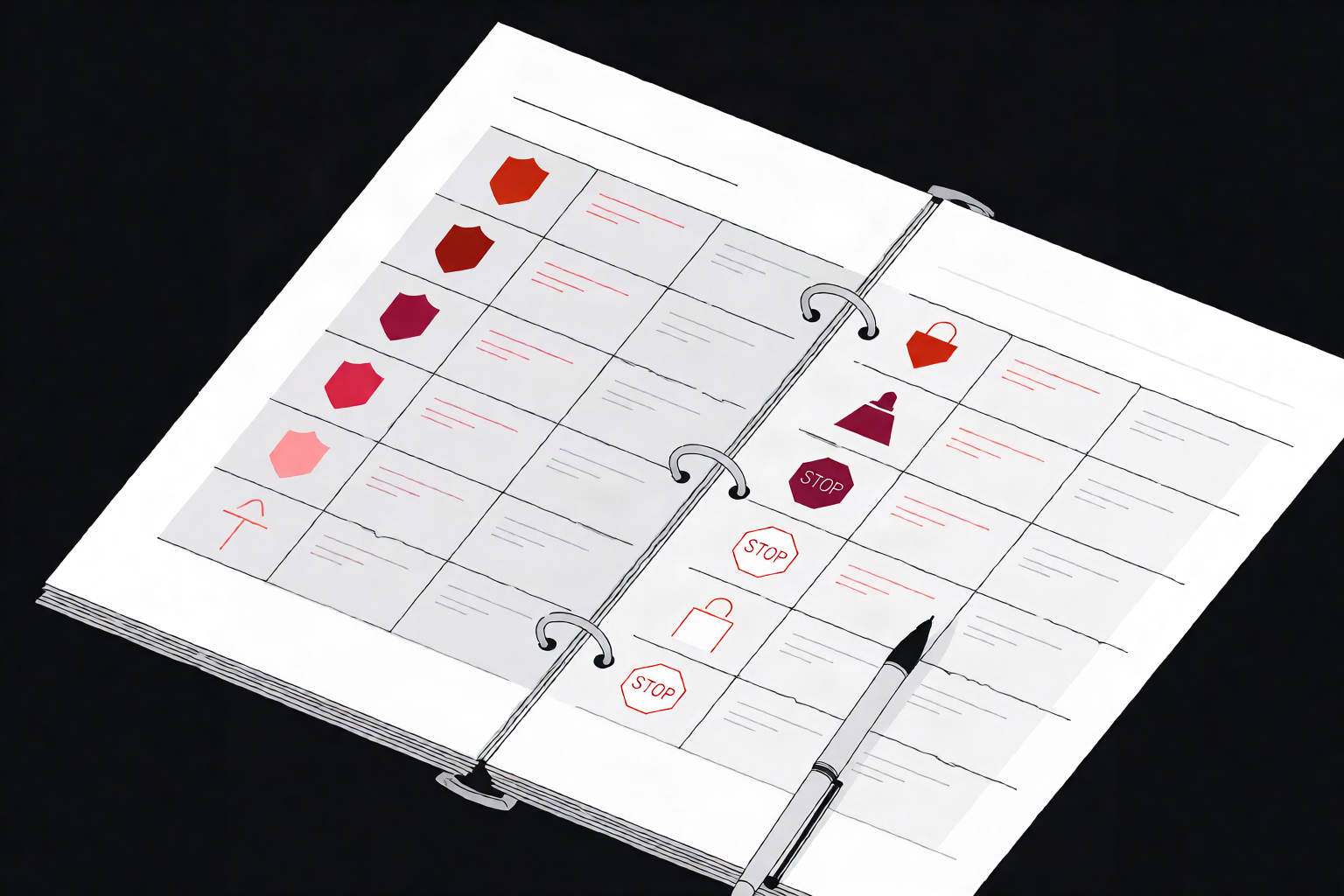
Everything you intend to automate gets decided here first, in a table a human wrote before any code exists. One row per incident class; each row pins down the trigger, the verdict, the action, and the rollback. If you can't fill in a row, that incident isn't ready for automation — it's still detection-only.
For each row, capture:
- Trigger — the exact signal and the threshold that fires it
- Verdict — allow, ask, or block
- Action — what the enforcement hook does, concretely
- Blast radius and reversibility — what breaks if the verdict is wrong, and how you undo it
- Owner — who tunes this row when it misfires
My first playbook had eleven classes and none of them were tuned. We shipped three and added the rest from real blocks. Do the same.
Step 2: Where does real-time detection hook into the tool-call path?
The practical integration point is a pre-tool-call hook: intercept every tool invocation, send the action and its intent to the guard, and enforce the returned verdict before the call executes. Scanning transcripts after the fact is still useful for forensics, but it cannot stop a call that already went out — which is the whole point of runtime AI security actions.
The interface is deliberately small. Action and intent in. Verdict — allow, ask, or block — plus calibrated scores out. One POST:
Two engineering decisions to make explicitly. First, give the check a hard timeout in the low hundreds of milliseconds — the guard is in the hot path of every call. Second, decide per tool class whether a guard outage fails open (availability wins) or fails closed (safety wins), and log which you chose. Silent fail-open is the worst outcome because nobody notices until an incident report references it.
Writing the rules the guard evaluates is its own exercise; we cover it in our guide to real-time policy enforcement for AI agents.
Step 3: Which responses should you automate first?
Automate the three threats with the clearest signals and cheapest wrong answers: prompt injection, data exfiltration, and out-of-scope writes. Everything else stays in the ask band until you have data.
| Trigger | Verdict | Automated response |
|---|---|---|
| Injection pattern detected in tool input | Block | Reject the call, return a reason code, log the pattern for the input-validation layer |
| Egress to an unapproved destination | Block | Drop the request, revoke the session token, notify on-call |
| Destructive or out-of-scope write | Ask | Pause execution, present the guard's evidence, wait for approval |
The enforcement snippet in Step 2 is the whole implementation — the work is in the playbook rows, not the code. For the exfiltration case specifically, the detection details (egress patterns, payload inspection, session revocation) are covered in our runtime guide to preventing AI agent data exfiltration, and the input side in our guide to real-time input validation against prompt injection.
One habit worth building immediately: every block opens a ticket against the root cause. A blocked exfil attempt means a scope was too broad or validation was missing. Remediation that only stops the symptom leaves the vulnerability in place for the next run.
Step 4: How does the agent self-correct — and how do you measure it?
Self-correction works only when a block comes back with a machine-readable reason the agent can act on: a missing scope means re-request a narrower action, a malformed parameter means retry with corrected arguments, a content refusal means regenerate and verify before acting. A bare "blocked" produces a retry loop, not self-correction.
Measure the loop with four numbers:
- False-block rate — legitimate calls blocked. Should fall as you tune; if it doesn't, the playbook row is wrong, not the threshold.
- Ask-to-approve ratio — if humans approve nearly every ask, your gray band is too wide and you've rebuilt rubber-stamping.
- Time-to-remediate — detection to containment. In-path remediation should read in seconds; if it reads in minutes, something is queueing.
- Repeat-incident rate per class — the only metric that tells you whether root causes are actually getting fixed.
Close the loop weekly: review blocked actions, edit playbook rows, recalibrate. Content verification is one of the better self-correction inputs — we describe the mechanism in our guide to real-time content verification for hallucinations.
Step 5: What should stay with a human?
Automate the reversible and contained. Escalate anything irreversible, high-blast-radius, or novel. Even vendors shipping AI remediation agents draw this line — Wiz describes its Green Agent as AI that investigates, assigns, and guides cloud remediation (Wiz's Green Agent announcement), which is to say: the AI prepares the decision, a human executes it.
| Automate when | Escalate when |
|---|---|
| The action is reversible in minutes | The action is irreversible — deletes, sends, payments |
| Blast radius is one session | Blast radius spans users or systems |
| The signal matches a playbook row exactly | The pattern is novel or scores in the gray band |
| Rollback is written and tested | Rollback is manual or unknown |
The first remediation loop I shipped blocked aggressively, and the false-block complaints arrived within days. The fix wasn't better thresholds — it was moving three classes from block to ask.
What are the common pitfalls in automated AI agent remediation?
Most failures I've seen are operational, not algorithmic: a guard that fails open silently, blocks without reasons, or gets tuned in production. All three are avoidable at design time.
| Pitfall | Symptom | Fix |
|---|---|---|
| Fail-open by default | Guard outage quietly disables enforcement | Choose fail-open vs fail-closed per tool class; log the choice |
| Blocking without a reason | Agent retries in a loop | Return machine-readable reason codes |
| Tuning in production | False blocks hit real users first | Run shadow mode; enforce only tuned rows |
| Guard as the whole defense | Allow-lists rot, scopes creep | Treat it as a complement to least privilege and allow-lists |
| Fixing symptoms only | Same incident class repeats | Every block feeds a root-cause ticket |
A guard that overpromises is worse than none. Say what it catches, measure it, and publish where it falls short — including to yourself.
A runnable next step
You don't need to build the detection layer to try the loop. Point a pre-tool-call hook at MCP Guard: one POST with the action and intent, one response with an allow/ask/block verdict and calibrated scores. Run it in shadow mode against your own traffic before you let it block anything — it complements your allow-lists and human approval, and it won't catch everything. The setup steps are on the site.
FAQ
What is AI agent remediation in practice?
It's an automated response layer that acts when an AI agent violates policy: blocking the tool call before it executes, revoking the session, or escalating to a human with evidence attached. The response happens inside the same request, not in a post-hoc review.
How is remediation different from detection and alerting?
Detection identifies a violation and tells you about it; remediation changes the outcome by stopping or containing the action in the same execution path. An alert that arrives after the agent has completed the call is a report, not a defense.
Can an AI agent self-correct after a blocked action?
Yes, but only if the block returns a machine-readable reason — a missing scope, a malformed parameter — the agent can act on. Without reason codes, a blocked agent just retries in a loop, and the right response is human review.
Does automated remediation replace allow-lists and least privilege?
No. The guard complements static controls: allow-lists and least privilege shrink what the agent can do, and runtime remediation catches what slips through those controls in the moment. Treat any claim of replacement as a red flag.
How do I roll out automated responses without breaking production?
Run the guard in shadow mode first and log verdicts without enforcing them. Tune the playbook rows against real traffic, enforce the block verdict on one or two narrow incident classes, then widen. Never tune thresholds on live users.
Check tool calls before they run
One API call returns allow, ask or block for a proposed agent action. 1,000 free requests, then $0.20 per 1,000 checks.
Topics
- AI agent remediation
- automated AI agent response
- real-time incident response AI
- AI agent security automation
- fixing AI agent vulnerabilities
- developer guide AI agent security
- AI agent self-correction
- runtime AI security actions