On this page (8 sections)
Dynamic trust zones are runtime boundaries that re-evaluate an AI agent's permissions before every tool call, returning an allow, ask, or block verdict with a calibrated trust score. Between mid-2024 and mid-2026, breaches hit Slack AI, GitHub's MCP server, and Microsoft 365 Copilot's EchoLeak because static trust models never re-checked context after the initial login. You build them as a pre-tool-call hook, not as a one-time login gate.
Key takeaways
- Dynamic trust zones evaluate context at each tool call, not just at authentication.
- A guard returns a verdict—allow, ask, or block—plus a trust score you can act on.
- They complement allow-lists, least privilege, and human approval; they do not replace them.
- You can start with a single pre-tool-call hook and one POST to an enforcement endpoint.
1. What are dynamic trust zones and why do AI agents need them now?
Dynamic trust zones are runtime boundaries that re-evaluate an AI agent's permissions before every tool call, returning an allow, ask, or block verdict with a calibrated trust score. Instead of trusting an agent because it authenticated once, you re-score trust using signals like user role, tool sensitivity, and recent behavior. This is how you implement zero trust for AI agents: no implicit trust, only continuous verification.
Static allow-lists break down the moment an agent chains tools or a prompt injects unexpected instructions. The industry saw this play out between mid-2024 and mid-2026, when breaches hit Slack AI, GitHub's MCP server, and Microsoft 365 Copilot's EchoLeak (Zylos Research, July 2026). AWS's agentic AI guidance treats trust boundaries between agents as a baseline control, not an option (AWS Well-Architected Agentic AI Lens).
Your goal is privilege escalation prevention: an agent that can read a calendar should not automatically be able to delete a database just because the user asked it to "handle everything."
2. Defining contextual boundaries: identifying key signals for trust evaluation

Trust evaluation is only as good as the signals you feed it. Before an agent calls a tool, you should know who the user is, what the tool can touch, which data the agent has already accessed, and whether the current session looks normal. These signals become the inputs to your trust score and the foundation of context-aware AI agent security.
Collect these signals at runtime:
- User identity and assigned role
- Tool sensitivity (read-only, write, destructive)
- Data classification of resources the tool touches
- Agent's recent call volume and target diversity
- Session age and time since last re-authentication
- Prompt provenance (user-authored, agent-generated, or external)
| Signal | Example | Trust impact |
|---|---|---|
| User role | Intern vs. admin | Lowers score for destructive tools |
| Tool sensitivity | Read CRM vs. delete database | Read-only raises, destructive lowers |
| Data accessed | Public docs vs. PII | PII access triggers re-evaluation |
| Call pattern | 5 calls/min vs. 200 calls/min | Spike suggests compromise |
| Prompt source | User typed vs. agent self-generated | Self-generated prompts need higher scrutiny |
These signals support runtime segmentation and microsegmentation for AI agents: you can isolate an agent's access to a single tool or dataset for one session, then tighten or loosen it as the score changes. Before you pick signals, map where your agents can actually reach (Mapping Your AI Agent Attack Surface).
3. Architecting for dynamism: integrating trust zone logic into your AI agent workflow
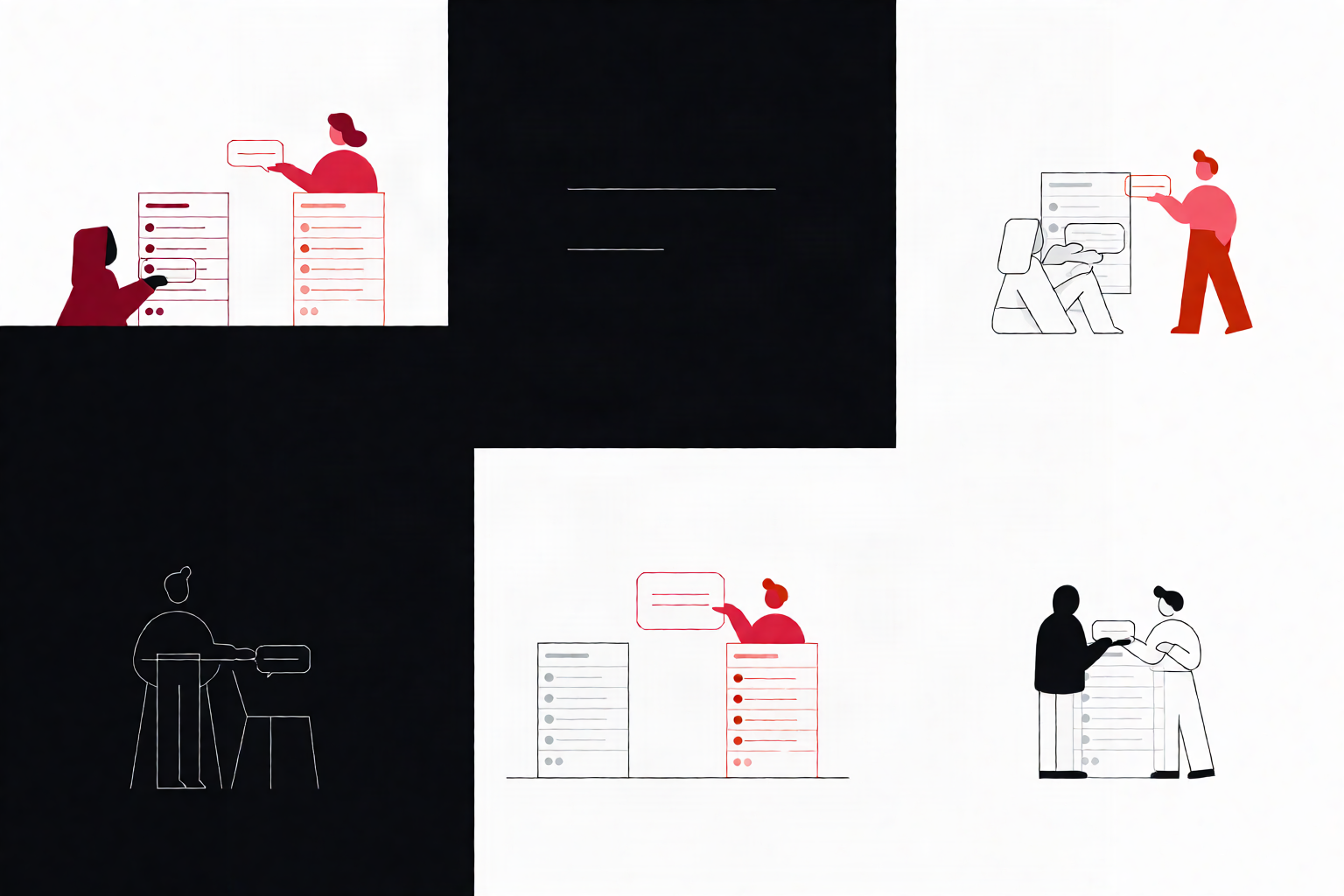
Put the trust zone check between the agent and the tool, not inside the agent. The agent sends a tool-call request to a pre-tool-call hook; the hook evaluates context and returns allow, ask, or block. The agent never touches the raw tool until the guard passes it through.
This architecture makes the trust zone adaptive. If the agent's score drops mid-session because it started accessing PII, the next tool call can be escalated to a human or blocked outright. That is adaptive security for AI agents: the policy changes as the context changes, not as a static config file.
Keep the hook lightweight. It should gather context, call the policy engine, and return a verdict in milliseconds. If it blocks, the agent should receive a structured error it can explain to the user, not a silent failure.
4. Implementing real-time trust evaluation: code examples for dynamic rule sets
A dynamic rule set starts with a base trust score and adjusts it by signal, then maps the final score to a verdict. You do not hard-code allow lists for every agent; you generate policy at runtime from the context you collected in step two. This is dynamic policy generation for AI agents in practice.
Here is the shape of the evaluation function. Treat the numbers as starting points, not measured constants:
The hook then enforces the verdict: allow proceeds, ask routes to a human approver, and block returns an error to the agent. Establishing trust at runtime means the score is recalculated on every call, not cached for the session (Curity: Establish Trust for AI Agents at Runtime).
Tune thresholds against your own telemetry. A score that blocks too often trains users to bypass the guard; a score that allows too much defeats the purpose. For more on granular control, see our guide on real-time policy enforcement for AI agents.
5. Measuring trust zone effectiveness: metrics and monitoring for adaptive security
You know a trust zone is working when you can see how often it blocks, asks, or allows, and whether the trust scores correlate with actual incidents. Without metrics, a dynamic policy is just a black box that might be blocking your legitimate agents or letting bad calls through.
Track these metrics:
| Metric | What it tells you | Alert when |
|---|---|---|
| Verdict distribution | Share of allow / ask / block | Sudden shift to block |
| Trust score drift | Baseline score moving over time | Drift > 0.2 in a week |
| Ask escalation resolution | How often humans approve or deny | High approval rate = weak threshold |
| Guard latency | ms added per tool call | > 100 ms p95 |
| Privilege escalation attempts | Calls blocked for exceeding zone | Any in production |
Pair these with your existing observability. If you see a spike in blocked calls, investigate whether the agent is compromised or your signals are too sensitive. For deeper runtime visibility, see our guide on real-time AI agent threat detection.
6. Challenges and considerations in deploying dynamic trust zones for AI agents
Dynamic trust zones fail when they add latency, generate false positives that break legitimate agent flows, or are treated as a complete security stack. They are a complement to allow-lists, least privilege, and human approval—not a replacement for any of them.
Watch for these issues:
- Prompt injection that mimics trusted context and inflates the trust score.
- Over-blocking that causes agents to fail silently or users to disable the guard.
- Score opacity: if developers cannot see why a call was blocked, they will not fix it.
- Signal staleness: user roles and data classifications change; your trust evaluation must reflect current state.
A guard that overpromises is worse than none. It does not catch every adversarial prompt or data exfiltration path. For runtime exfiltration controls, see our developer's guide to preventing AI agent data exfiltration.
7. Runnable next steps: integrating MCP Guard for dynamic trust zone enforcement
The fastest way to start is to instrument one pre-tool-call hook and send each request to an enforcement endpoint. MCP Guard exposes this as a single POST where you pass the agent, tool, user, and context, and receive a verdict plus score. You enforce the verdict in your agent runner before the tool executes.
- Add a pre-tool-call hook in your agent framework.
- POST
{agent_id, tool, user, context}to the MCP Guard evaluation endpoint. - Enforce the returned verdict: allow, route to human for ask, or block.
- Log verdicts and scores for one week before tightening thresholds.
This keeps the guard as a complement to your existing controls. If you want to try it, the MCP Guard endpoint and docs are at mcp-guard.ai. Start with one tool, log the verdicts, and tighten thresholds as you see what your agents actually do.
FAQ
How is dynamic trust different from zero trust for AI agents?
Zero trust is the philosophy that nothing is trusted by default. Dynamic trust zones are the mechanism: they enforce that philosophy at runtime by re-scoring every tool call instead of trusting a single login.
Can dynamic trust zones prevent AI agent privilege escalation?
Yes, by design. A trust zone can block an agent from calling a destructive tool even if the agent previously accessed a less sensitive tool in the same session.
Do I need microsegmentation for AI agents if I use dynamic trust zones?
They work together. Microsegmentation limits network reach; dynamic trust zones decide whether a specific tool call should be allowed based on live context.
Does a trust zone guard replace human approval?
No. The "ask" verdict exists specifically to route risky calls to a human. Automation handles the obvious cases; humans handle the edge cases.
What latency should I expect from real-time trust evaluation?
It depends on your hook and endpoint, but the guard should return a verdict in milliseconds. If it adds more than about 100 ms at the p95, optimize the hook or cache static signals.
Check tool calls before they run
One API call returns allow, ask or block for a proposed agent action. 1,000 free requests, then $0.20 per 1,000 checks.
Topics
- dynamic trust zones AI agents
- adaptive security for AI agents
- AI agent runtime segmentation
- microsegmentation for AI agents
- context-aware AI agent security
- real-time trust evaluation AI
- AI agent privilege escalation prevention
- dynamic policy generation AI agents